Saturday, 5 April 2014

N. 53: O. R. Di Iorio

G. it. Ent., 11 (53): 183-234
May 2006

Torneutini of Argentina: New records, host plants,
and comparison of their larval and adult biologies with those of
Prioninae and Trachyderini (Coleoptera: Cerambycidae)

by

OSVALDO R. DI IORIO

Abstract - New records are given for Dragomiris quadricornutus Gounelle, 1913, Dragoneutes baculus (Gounelle, 1913), Macellidiopygus debilis Gounelle, 1913, Psygmatocerus pubescens Bruch, 1926, Ranqueles gounellei Bosq, 1947, Ranqueles mus Gounelle, 1906, Scapanopygus cinereus Gounelle, 1913, Spathopygus eburioides (Blanchard, 1843) and Torneutes pallidipennis Reich, 1837. Larval tunnels, pupal chambers and emergence holes are illustrated and described for Dragomiris quadricornutus (male and female), Ranqueles gounellei, Scapanopygus cinereus, Torneutes pallidipennis (male and female), and one "trace-maker species" (larvae and adults not found). Adult behaviour of Dragomiris quadricornutus is described. The death-feigning posture of Ranqueles gounellei is described and illustrated for the first time. First and last instar larva girdlings, new host plant records, phenology, adult mating behaviour, oviposition, parasitoids, inquilines and predation of larvae and adults by birds are reported for Torneutes pallidipennis. It is verified that more than one species of Torneutini may infest a single plant. Host plants, sympatry and cohabitation, oviposition, larval tunnels and girdlings, emergence holes, superposition of generations, larval survival, copulation, flying and predation, host plant reinfestation, and comparison with Prioninae and Trachyderini for larval and adult biologies are widely reported for Torneutini.


N. 53: Bert Kohlmann & Angel Solís

G. it. Ent., 11 (53): 235-295
May 2006

El género Canthidium (Coleoptera: Scarabaeidae)
en Norteamérica

por

BERT KOHLMANN y ANGEL SOLÍS

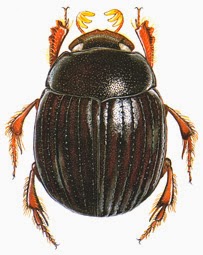
Abstract - The genus Canthidium (Coleoptera: Scarabaeidae) in North America - This paper is the result of the study of the genus Canthidium Erichson (Coleoptera: Scarabaeidae) in North America. Thirteen species are reported, seven of them are new. The known species are: C. ardens Bates, C. centrale Boucomont, C. hespenheidei Howden & Young, C. laetum Harold, C. pseudopuncticolle Solís & Kohlmann and C. smithi Bates. The new taxa are: C. andersoni n. sp., C. delgadoi n. sp., C. howdeni n. sp., C. macclevei n. sp., C. moroni n. sp., C. pseudoperceptibile n. sp. and C. riverai n. sp. The following taxon between brackets is placed in synonymy: (C. rhodopus Bates, 1887) = C. ardens Bates, 1887. Two species are brachypterous: C. howdeni n. sp. and C. riverai n. sp. Photographs of the dorsal aspect of all species are included, as well as line drawings of important morphological characteristics and a distribution map. Drawings of the dorsal habitus for all species are also included. An identification key is presented.


N. 53: A. Ballerio

G. it. Ent., 11 (53): 297-306
May 2006

A review of the secondary sexually dimorphic characters
in the Ceratocanthinae
(Coleoptera: Scarabaeoidea: Ceratocanthidae)

by

ALBERTO BALLERIO

Abstract - Most known genera of the Ceratocanthinae (Coleoptera, Ceratocanthidae) show a series of distinctive patterns of secondary sexual dimorphism. In the literature, the sexually dimorphic characters in the family have never been emphasized, and in many genera the sexual dimorphism, although conspicuous, has never been described. An analysis carried out on all the recognized genera of Ceratocanthinae shows that the following body parts are affected by sexual dimorphism: male protarsi (Eusphaeropeltis), the apical teeth of male and female protibiae (Ebbrittoniella, Paulianostes, Cyphopisthes), female protibiae (Melanophilharmostes, Goudotostes, Callophilharmostes, Carinophilharmostes, Petrovitzostes), the male apical spur of protibiae (many genera), the male inner apical spur of mesotibiae (most genera), the apical portion of metatibiae (some species of Germarostes), the inner apical spur of metatibiae (Pterorthochaetes), head (Melanophilharmostes, Goudotostes, Madrasostes clypeale), and pronotum (punctation) (Madrasostes clypeale). The functional meaning of these structures - any observation on the mating behavior and oviposition of these beetles lacking - may only be hypothesized, while the usefulness of these characters in reconstructing the phylogeny and in evaluating natural groups within the subfamily, is still not clear. Nevertheless, a preliminary analysis suggests that homogeneous groups of species usually show the same sexual dimorphism and that groups of genera often exhibit the same sexually dimorphic pattern.


N. 53: A. Ballerio

G. it. Ent., 11 (53): 307-313
May 2006

The enigmatic Afrotropical genus Afrocloetus Petrovitz, 1968,
with description of a second species from Kenya
(Coleoptera: Scarabaeoidea: Ceratocanthidae)

by

ALBERTO BALLERIO

Abstract - Afrocloetus forshagei n. sp. is described from a coastal forest of Kenya. The only other species belonging to the genus (A. gibbosus) is re-described. The current spelling of the genus (Afrocloetus) is emended. Some remarks on the phylogenetic position and definition of the genus are added.


N. 53: G. Goggi

G. it. Ent., 11 (53): 315-323
May 2006

Indagine faunistica sui Cerambicidi (Coleoptera, Cerambycidae)
della Valsassina (Lecco, Lombardia)

di

GIANPIETRO GOGGI

Abstract - Faunistic research on the Cerambycids (Coleoptera, Cerambycidae) of the Valsassina (Lecco, Lombardy, N. Italy) - The research gives important information on the Cerambycidae of this mountain valley of North Italy. For each species the altitude and plant of collection are given. Comparing the fauna of the valley with that of Italy, the subfamilies Lepturinae and Lamiinae show opposite data regarding their relative presence.

N. 53: R. Pittino

G. it. Ent., 11 (53): 325-342
May 2006

A revision of the genus Psammoporus Thomson, 1859 in Europe,
with description of two new species
(Coleoptera Scarabaeoidea: Aegialiidae)

by

RICCARDO PITTINO

Abstract - A revision of the genus Psammoporus Thomson, 1859 in Europe - carried out on 602 specimens - is hereby presented. The identification of the species is based on the correlation between external morphology and internal structures, i.e. male genitalia (parameres and sclerites of the endophallus) and female genital plate (styli of the ovipositor and spermatheca). The genus is present in Europe with four closely allied species: 1) Psammoporus sabuleti (Panzer, 1797), whose lectotype is hereby designated, widespread throughout North Europe; 2) P. latipunctus (Gredler, 1866), with a restricted range: N. Italy, Switzerland, Austria and S. Germany; 3) P. mimicus n. sp. (Type loc.: Switzerland, Luzern: Hasle), widespread throughout central Europe; 4) P. insularis n. sp. (Type loc.: England, Cumberland, Baron's Wood), apparently endemic to Great Britain. Bibliographic references, description, verified localities, range, illustrations of both male and female genitalia are given for each species. A key to species is included.

N. 53: C. Pignataro & S. Vicidomini

G. it. Ent., 11 (53): 343-346
May 2006

Scarabaeoidea (Coleoptera)
presenti nelle collezioni entomologiche del
Museo Naturalistico degli Alburni (Corleto Monforte, Salerno):
reperti della Campania

di

CAMILLO PIGNATARO & SALVATORE VICIDOMINI

Abstract - The Scarabaeoidea (Coleoptera) of the entomological collection of the Natural History Museum of the Alburni (Corleo Monforte, Salerno, Italy): the specimens from Campania - To list the specimens of Scarabaeoidea of the entomological collection of the Natural History Museum of the Alburni is the aim of this paper. The 291 specimens belong to the following families (no. of genera, no. of species, no. of specimens): Aphodiidae (1, 10, 43); Cetoniidae (8, 10, 53); Dynastidae (1, 1, 46); Geotrupidae (4, 5, 28); Melolonthidae (5, 5, 25); Pachypodidae (1, 1, 1); Rutelidae (1, 1, 1); Scarabaeidae (7, 16, 87); Trogidae (1, 2, 7). 263 specimens were collected in the Salerno province, in the Alburni especially, 28 in the provinces of Naples (23), Caserta (2), Avellino (3).